
by Sam P.K. Collins and Maven McGann
During the latter part of June, the Washington Metropolitan Area Transport Authority (WMATA) rolled out a revamp of the decades-old bus system with the goal of improving frequency and reliability.
However, less than a week into what’s known as Better Bus Network Redesign Project, several bus riders, including one who once used the bus to pursue their K-12 education, said the changes are more than they can bear.
“The first bus I took was the wrong one. I’m now 30 minutes late,” Southeast D.C. resident Adariah George said on the morning of July 3 while on her way to her job at a local summer camp.
George, an 18-year-old newly minted alumna of KIPP Legacy College Preparatory Public Charter School in Southeast, said she has used the Metrobus throughout much of her educational career. In recent years, the A bus line, which touched Anacostia Metro Station, Livingston Road, Martin Luther King Jr. Avenue SE and Southern Avenue SE, counted as her go-to routes of choice.
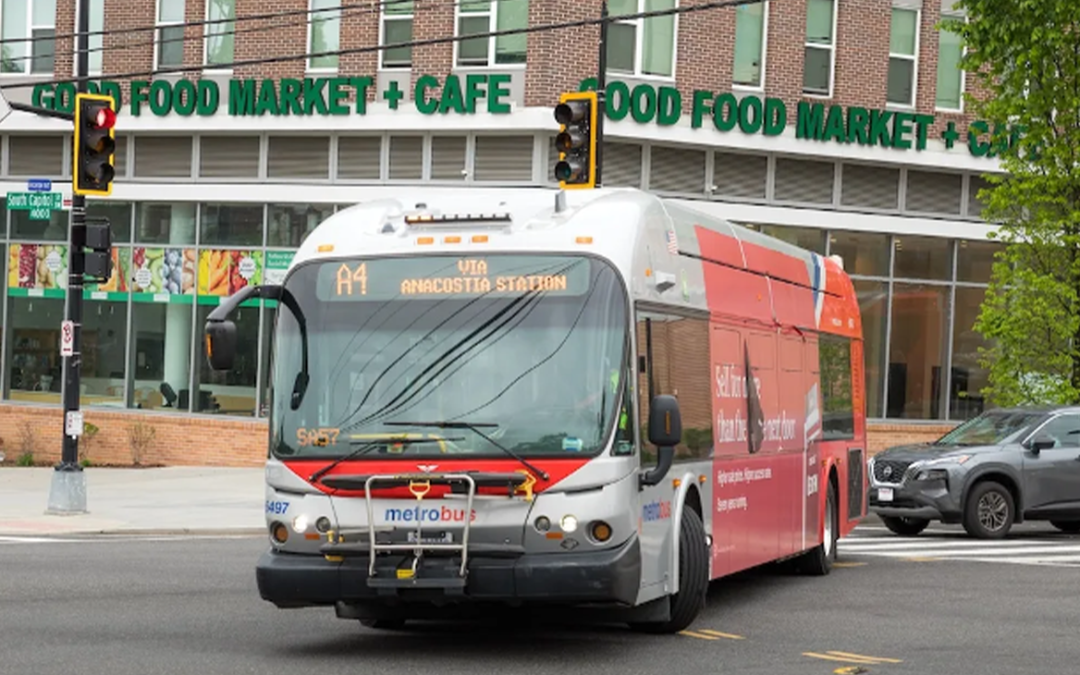
Those routes, now consolidated into C11, run similarly to what was formerly known as the A4, A8, P6 and the 35. However, George said the fewer stops and somewhat of a new route threw her into a state of frenzy.
“They’re taking buses away from where I’m close to, so now I have to go further for a bus stop,” George said about the new route, noting she knows of other youth in the D.C. metropolitan area who have had similar experiences. “You have to leave out earlier because it’s going all around everywhere except straight to a certain destination, so it just takes longer to get everywhere. It’s less accessible from certain areas.”
As Changes Get Underway, WMATA Officials Engage Riders
On June 29, WMATA launched the Better Bus Network, its first systemwide overhaul of the Metrobus system in half a century.
The redesign changed the name of every route, removed more than 500 stops, and restructured schedules. The first letter of each route is now dictated by its direction (C for crosstown and D for downtown) or destination (A for Virginia’s Alexandria City and Arlington County; F for Fairfax County, Virginia; M for Montgomery County, Maryland; and P for Prince George’s County, Maryland).
The names of limited and express routes end with X.
Additionally, buses on 11 new routes are scheduled to run every 12 to 20 minutes throughout the day, offering more frequent service for high-traffic stations. The new bus system also aims to better connect riders to L’Enfant Plaza in Southwest, and Maryland’s Downtown Silver Spring and National Harbor.
WMATA officials say the Better Bus Network, intended to increase bus frequency and service as well as produce clearer routes, follows years of community engagement, rider surveys, and transit data. Days into the bus system revamp, they reported what they described as minor issues, including missing signs at bus stops.
Earlier this month, WMATA officials availed themselves to residents and tourists using the regional transit system.
Randy Clarke, WMATA general manager and CEO, acknowledged that the transition has been harder for some than others. He expressed plans to engage residents in August as students and families prepare for the new school year.
“You generally hear more from people that are not as happy as people that are happy, but we are monitoring that very closely,” Clarke told The Informer. “Most people that take the bus are residents of our region, and once they learn the new trick, they’re good to go.”
A Variety of Viewpoints About the Better Bus Network
While, to some WMATA officials, the short-term discomfort pales in comparison to the overall goal of the Better Bus Network, bus riders throughout the D.C. metropolitan area are struggling to navigate their communities.
For instance, a D.C. government employee who requested anonymity said they felt out of place on the new bus system.
“It feels like we’re part of some big experiment that nobody explained to us,” the D.C. government employee said.
Joshua Boone, a native Washingtonian who’s taken the Metrobus more than half of his life, experienced a similar change for what was formerly known as the A4.
“I prefer the old one because I had just moved to Southwest and was finally getting that bus route down,” said Boone, an IT specialist. “Now I gotta just do a little more adjusting.”
For Boone, young people would count among those most affected by the Better Bus Network.
“Some don’t have cars, most don’t have credit cards for Ubers,” he said. “They’re the ones who have to figure it out the hard way.”
Much to Boone’s amazement, the newly named bus line still drops him off in front of his apartment building. Until he gets his slightly adjusted route down pat however, he continues to lean on WMATA’s online trip tools as a guide.
It’ll let you know how many minutes until it comes,” Boone said. “I think it has been pretty accurate the last few times I’ve used it”
Elleanore Hancock, a Southeast resident who rides the bus daily, said she doesn’t understand why WMATA changed the entire bus system.
“They’re making me feel very frustrated and a little bit conflicted because I have to do the utmost unnecessary things,” Hancock said. “Before, you could just put in a stop number. Now you can put in a stop number, but you have to actually check the bus route and see where it goes. If you don’t pregame, you’re just null and void, you’re out of it.”
Reina Carroll, another bus rider who said she depends on the transit system to get to her jobs, said she has both complaints and positive feedback for the Better Bus Network.
“They made the routes longer which adds longer wait times between buses,” said Carroll, a Congress Heights resident of five years. “But the C11 and C15 bus change makes it easier to get to Eastover and Navy Yard without having to get off and walk far.”
Even so, Carroll admits that she has yet to get acclimated to the new bus system.
“I don’t know where the bus is taking me half the time,” she told The Informer.


RECENT COMMENTS